
Is AI Driving Up Your Electric Bill? The Hidden AI Power Surcharge

Your electric bill may be rising for reasons that have nothing to do with your thermostat, dishwasher, or holiday lights.
Across the U.S., utilities are preparing for a surge in electricity demand from large data centers, including the facilities that power artificial intelligence tools. Those data centers need huge amounts of always-on electricity. To serve them, utilities often propose new transmission lines, substations, power plants, and grid upgrades. The cost can show up in household bills through higher base rates, riders, and delivery charges.
That is the hidden AI Power Surcharge: not a line item with that name, but a real cost shift that can land on residential customers.
TL;DR
AI data centers use large amounts of electricity around the clock, which can strain local grids in major data center hubs.
Utilities often recover grid expansion costs through rate cases, base-rate increases, fuel adjustments, and infrastructure riders.
Homeowners can protect themselves by reading rate filings, checking bill line items, using Time-of-Use rates carefully, and claiming local efficiency or solar programs.

The short answer is yes, but indirectly
AI is not plugging into your laundry room. A chatbot session is not directly charging your home account.
The connection is indirect, but financially important.
When a utility expects fast-growing demand from data centers, it may need to build or buy more capacity. That can include:
New transmission lines
Substation upgrades
Distribution system improvements
Backup generation or power purchase agreements
Grid control and reliability equipment
New natural gas plants, renewable projects, batteries, or interconnection upgrades
Utilities do not usually pay for those investments from profits alone. They ask state regulators for permission to recover costs from customers. If approved, those costs can be spread across ratepayers for years.
That is why residential customers should care. A massive data center campus may be built miles away, but the financing can move through the same regulated utility system that serves homes.
What the AI Power Surcharge really means
The phrase AI Power Surcharge is a useful label for a cost pattern, not an official charge found on most bills.
It describes the way AI-driven data center growth can raise utility costs for households, even when the bill does not mention AI.
A typical residential bill has several pieces:
Customer charge
A fixed monthly fee for being connected to the system.
Energy charge
The price per kilowatt-hour used.
Delivery or distribution charge
The cost of moving power through local wires and equipment.
Transmission charge
The cost of high-voltage power movement over longer distances.
Fuel or power supply adjustment
A charge that can rise when utilities pay more for fuel or wholesale power.
Riders and surcharges
Extra charges approved for specific investments, programs, storm recovery, efficiency, or infrastructure.
The AI Power Surcharge can hide inside any of these. A household may see a higher base rate, a new infrastructure rider, or a delivery charge that grows faster than energy usage. The bill looks ordinary. The drivers behind it are not.
A lower thermostat setting can help, but it cannot cancel out a utility-wide rate increase approved by regulators.
Why data centers use so much electricity
Data centers are not just large buildings full of computers. They are dense electrical loads that run day and night.
AI systems raise the stakes because training and running advanced models often require specialized chips, intense cooling, and constant uptime. Even after a model is trained, everyday AI use still requires servers to process requests, store data, and move information across networks.
A large data center can use as much electricity as a small city. A cluster of them can change a region’s power forecast.
Utilities plan the grid around peak demand, reliability rules, and long-term growth. When a data center developer requests hundreds of megawatts of service, the utility must answer a hard question: can the existing system handle it?
Often, the answer is no.
That can trigger upgrades to substations, transmission corridors, transformers, and generation resources. In regions where many projects arrive at once, the queue gets crowded. Utilities then file plans that ask regulators to approve billions of dollars in spending.

How grid expansion costs reach residential bills
Most investor-owned utilities operate under state regulation. They make capital investments, then seek approval to recover those costs plus a regulated return.
The process usually works like this:
Demand forecasts rise
Utilities update long-term planning models to include data center load, industrial growth, electric vehicles, heat pumps, and population changes.
Utilities propose new spending
They file integrated resource plans, transmission plans, or rate cases. These filings explain what they want to build and how much they expect it to cost.
Regulators review the requests
State public utility commissions decide which costs are reasonable and how to divide them among customer classes.
Rates change
If regulators approve the request, households may pay more through base rates, riders, or supply charges.
Bills rise even if usage stays flat
A family can use the same number of kilowatt-hours as last year and still pay more because the price per unit, fixed charges, or delivery costs increased.
This is the key personal-finance point: your bill is usage multiplied by rates, plus fixed charges and adjustments. Cutting usage helps, but rate increases change the math for everyone.
Data center hubs are seeing sharper pressure
Electricity prices vary by state, utility, generation mix, weather, fuel costs, and regulation. Data centers are only one factor. Storm recovery, natural gas prices, aging infrastructure, and clean energy mandates also affect rates.
Still, the overlap is hard to ignore. Some of the fastest-growing data center regions are also places where utilities are planning major grid investments.
The table below uses rounded, directional figures based on publicly reported retail electricity trends and utility-rate activity. Check current rates with your state regulator or utility tariff, since prices change by month, provider, and customer class.
Region | Why it matters for data centers | Recent residential rate pressure | How it compares with the national trend |
Northern Virginia | One of the largest data center markets in the world, with heavy demand around Loudoun County and nearby areas | Residential prices have risen notably over recent years, along with major transmission and distribution planning needs | Similar to or above the national increase in many local service areas |
Central Ohio | Fast-growing cloud and AI infrastructure market near Columbus and surrounding counties | Customers have faced higher supply prices and utility rate pressure, depending on provider and tariff | Often above the national average during periods of high wholesale supply costs |
Texas | Large data center growth, especially near Dallas, Fort Worth, Austin, and other grid-constrained areas | Prices vary widely in deregulated markets, but transmission and reliability costs have become more visible | Can rise faster than the national trend during high-demand and grid-stress periods |
U.S. average | National benchmark across all residential customers | Residential electricity prices rose meaningfully from pre-pandemic levels into the mid-2020s | Baseline for comparison, but local rates can move much faster |
The takeaway is not that every rate increase comes from AI. The better conclusion is more practical: data center growth can add a new layer of cost pressure in regions already dealing with aging infrastructure, extreme weather, and rising demand.
Where to look for the hidden charge on your bill
The AI Power Surcharge usually does not appear as a neat line called “AI.” Look for these clues instead.
Base rate increases
A base-rate increase changes the approved price structure for electricity service. It can raise fixed monthly charges, per-kWh rates, or both.
If your bill rose even though your usage stayed flat, compare:
kWh used this month versus the same month last year
Total bill this month versus the same month last year
Average cost per kWh
Customer charge
Delivery and transmission charges
To find your average cost per kWh, divide the total bill by total kWh used.
For example, a $180 bill divided by 1,000 kWh equals 18 cents per kWh.
Infrastructure riders
Riders can fund specific utility investments. Some are small at first, then grow over time. A rider may cover grid modernization, transmission upgrades, power plants, storm hardening, or regulatory costs.
Look for line items with words such as:
Rider
Adjustment
Recovery
Infrastructure
Transmission
Distribution
Capacity
Fuel
Purchased power
Delivery charges rising faster than energy charges
If generation supply looks stable but delivery charges keep climbing, the issue may be the cost of wires, poles, substations, transformers, or transmission service.
That is often where data center-related grid expansion appears.
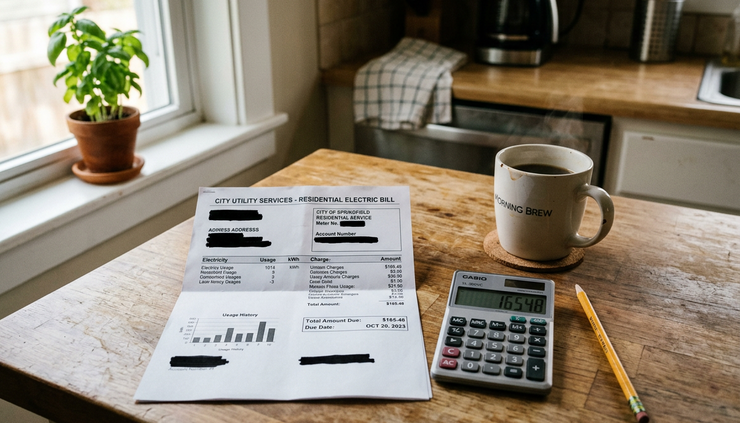
A 3-step plan to protect your household budget
This is informational only and not financial advice. Utility rules vary by state, provider, and rate plan.
1. Audit your local utility rate filings and bill line items
Start with your own bill, then move outward to public filings.
Pull your last 12 months of electric bills and create a simple spreadsheet with:
Billing month
kWh used
Total bill
Customer charge
Energy or supply charge
Delivery charge
Transmission charge
Riders or adjustments
Average cost per kWh
This separates a usage problem from a rate problem.
Next, search your state public utility commission website for your utility’s name plus terms like:
`rate case`
`base rate increase`
`integrated resource plan`
`transmission rider`
`data center load`
`large load tariff`
`cost allocation`
Look for plain-language summaries from consumer advocates, commission staff, or the utility. The most useful documents often explain:
How much the utility wants to raise rates
Which investments are driving the request
How costs are split among residential, commercial, and industrial customers
Whether large-load customers get special tariffs or protections
When new rates would take effect
Pay special attention to cost allocation. If a data center requires new infrastructure, the central question is who pays: the data center, all customers, or some mix of both.
2. Use Time-of-Use rates and off-peak scheduling carefully
Time-of-Use, or TOU, rates charge different prices depending on when electricity is used. Peak hours cost more. Off-peak hours cost less.
TOU can help if your household can shift flexible usage away from peak times.
Good candidates for off-peak scheduling include:
EV charging
Dishwashers with delay start
Laundry
Electric water heating, if your system and utility plan allow it
Pool pumps
Battery charging
Pre-cooling or pre-heating before peak windows
Before switching, compare your actual habits. TOU can backfire if someone works from home during peak summer hours, relies heavily on air conditioning late in the day, or cannot move major loads overnight.
Ask your utility for a bill comparison tool. Many utilities can estimate whether TOU would have saved money based on past usage.
If your provider offers smart meter data, review your hourly usage. The goal is simple: use less electricity when the grid is most stressed and rates are highest.
3. Claim local efficiency programs and community solar credits
Efficiency upgrades can protect against rate hikes because they lower the number of kWh exposed to higher prices.
Start with no-cost and low-cost programs from your utility, city, state energy office, or local nonprofit. Common offers include:
Home energy audits
LED bulb kits
Smart thermostat rebates
Heat pump water heater rebates
Weatherization support
Attic insulation rebates
Appliance recycling programs
Income-qualified bill assistance
Demand response credits
Community solar can also help in some states. Instead of installing panels on your roof, you subscribe to a local solar project and receive bill credits. The savings vary, and contracts matter, so read cancellation terms, credit formulas, and fees.
A useful rule: prioritize programs that reduce your bill without locking you into long contracts. Rebates, audits, insulation, and smarter scheduling usually carry less risk than complicated financing offers.
What to ask before your utility raises rates
When a utility requests a rate increase, residential customers can submit comments to the state commission. Even a short, factual comment can help regulators see household impact.
Ask direct questions:
Are data centers or other large-load customers driving new infrastructure costs?
Will large customers pay upfront contributions for grid upgrades?
Are there minimum-demand charges for new data centers?
Are residential customers protected from stranded costs if a large customer cancels a project?
How much of the increase affects fixed monthly charges versus usage-based charges?
Are low-income customers protected from higher winter or summer bills?
Does the plan include efficiency, demand response, or distributed energy options that could reduce the need for new infrastructure?
These questions matter because fixed charges reduce customer control. If more of the bill moves into fixed fees, using less electricity saves less money.
Usage-based pricing gives households more power to manage costs.

The policy fight behind your monthly bill
The rising demand from AI data centers creates a real economic benefit. These projects can bring construction jobs, tax revenue, and digital infrastructure. They also support services that many households and businesses now use every day.
The conflict is over cost and risk.
If a data center requires a new substation or transmission line, should all customers pay because the upgrade strengthens the grid? Or should the company creating the new demand pay most of the cost?
There is no single national answer. Utility regulation happens mostly at the state level. That means consumer protections can differ widely.
Some regulators are beginning to focus on large-load tariffs, minimum contract terms, upfront payments, and safeguards against stranded costs. Those tools aim to prevent a data center from triggering expensive upgrades, then leaving ordinary customers with the bill if demand forecasts fall short.
For households, the practical move is to watch the local process. The national AI boom becomes a family budget issue only when state regulators approve costs in local rates.
The bottom line for homeowners
AI can raise your electric bill indirectly by increasing demand for grid capacity in data center-heavy regions. The charge will usually look like a normal rate increase, delivery charge, transmission rider, or infrastructure adjustment.
The best defense is not panic. It is bill literacy.
Track your usage, calculate your average cost per kWh, read rate-case summaries, and check whether your utility offers TOU pricing, rebates, audits, or community solar credits. If a rate case mentions large-load growth or data center demand, pay attention to who pays for the upgrades.
The AI Power Surcharge may be hidden, but it is not invisible. Once you know where to look, you can spot it sooner and make better choices before the next bill arrives.


Comments